

 Blog
BlogThe Mekong Delta carries a softness you can only understand once your feet touch its soil — a calm warmth shaped by winding waterways, rustling coconut groves, and locals whose friendliness arrives as naturally as the rising sun. I began this journey expecting to admire scenery; instead, I stepped into a world built on flowing rivers, long-held traditions, and everyday joys.
Often described as Vietnam’s “rice bowl,” the Mekong Delta is far more than fields and farms. Here, rivers act as roads, floating markets function like open-air supermarkets, and every turn of a canal reveals glimpses of a life lived closely with nature. Through days exploring Can Tho, Ben Tre, Vinh Long, and tiny islets hidden among water channels, I discovered a gentler Vietnam — one that moves at a peaceful pace and invites travelers to slow their steps.
Entering the Delta: Life That Begins With Water
From the moment you arrive, the landscape transforms. The land stretches out flat, rice fields spread endlessly, and waterways appear in every direction — narrow canals lined with coconut palms, broad rivers carrying cargo, and streams flowing into quiet riverside communities.
Boats aren’t just transportation here; they’re part of daily life.
Children row to school, vendors maneuver between houses floating on the water, and fishermen navigate the early-morning mist with practiced ease. Even the air feels different: warm, humid, and scented with ripe fruit and freshly tilled soil.
Your adventure begins not at a famous attraction but the instant you step onto a boat and let the river lead the way.
Cai Rang Floating Market: The Heartbeat of the River
My first dawn in Can Tho began before sunrise. The river was dark and silent as our boat drifted forward. Slowly, the sky shifted from deep indigo to a gentle pink, like the Delta stretching awake.
Then the stillness broke.
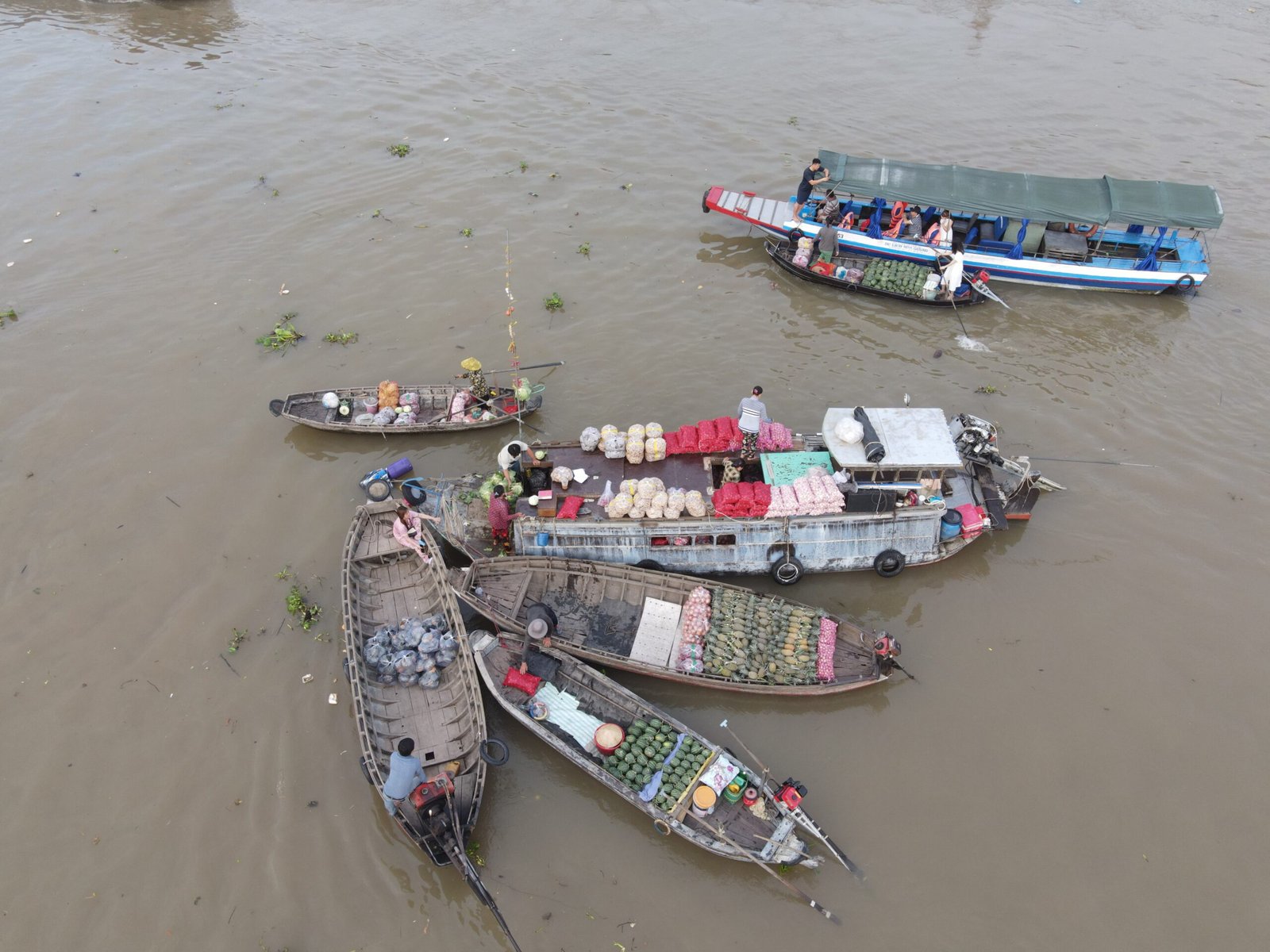
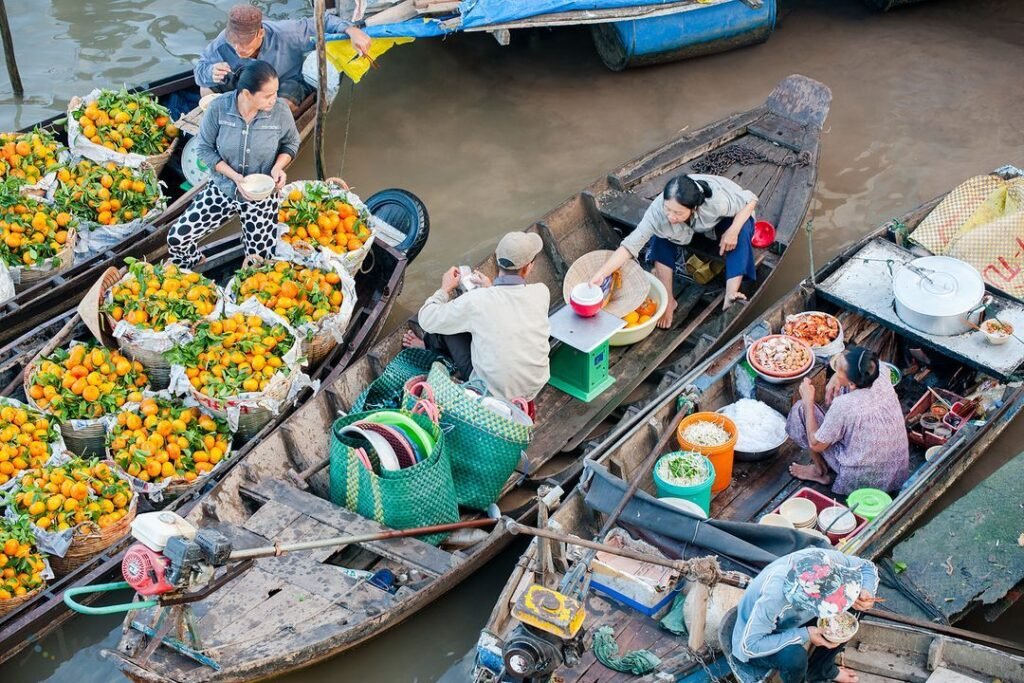
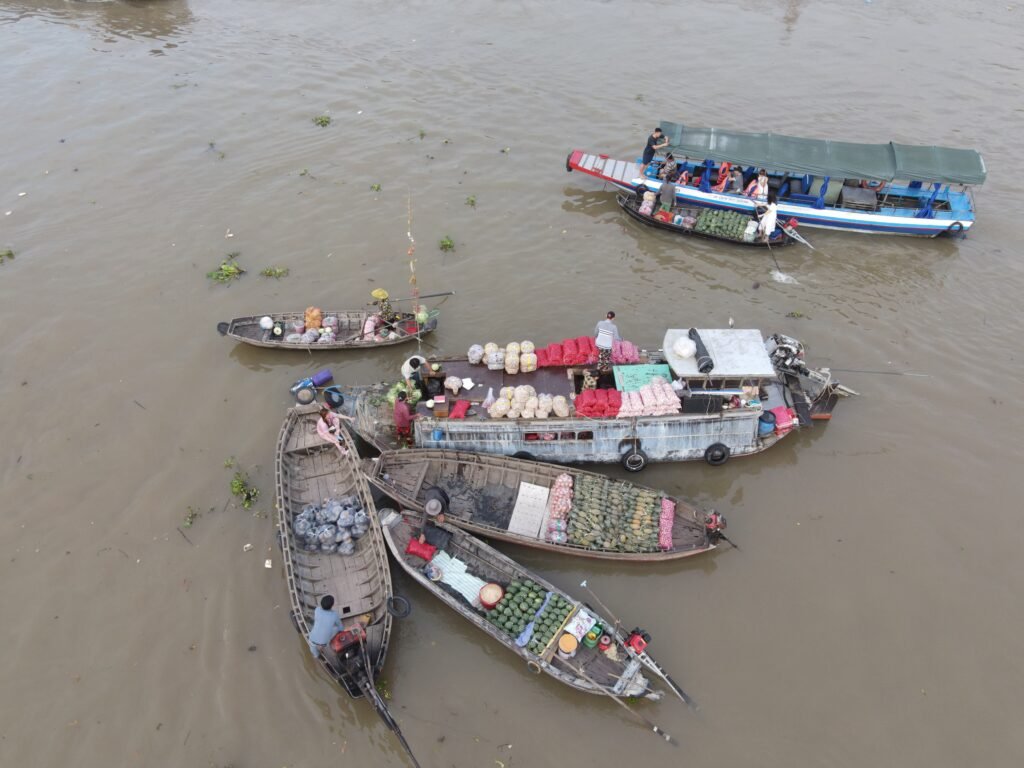
Cai Rang Floating Market appeared in full motion — boats of every size crowding the river, each loaded with fruits, vegetables, flowers, or everyday goods. Tall bamboo poles rose from the decks, displaying pineapples, pumpkins, cabbages, and more like floating signposts.
Voices called across the water. Engines hummed. Waves slapped against the hulls. A vendor preparing hủ tiếu approached us on her tiny boat. Balancing on the rocking planks, she handed me a steaming bowl. Eating noodles while drifting through a bustling river market felt like stepping into a scene I’d only ever watched on documentaries.
Islets and Gardens: Fruit Orchards and Warm Hospitality
From Can Tho, I continued toward Vinh Long and An Binh islet — a lush maze tucked between river branches.
Here, the rhythm slows.
Narrow footpaths weave through orchards of rambutan, longan, jackfruit, and water coconut. Farmers welcomed me to taste fruit straight from the tree — warm, sun-kissed, and sweeter than anything from a store. A rambutan picked fresh tastes like sunshine mixed with earth and a bit of local love.
A family invited me to stay at their riverside home. At night, the only sounds were cicadas and distant paddles. After dinner, they performed đờn ca tài tử — a traditional Southern musical art recognized by UNESCO. Even without understanding every lyric, I felt the emotion in their voices.
Generosity is a defining trait of the Mekong — simple, sincere, and abundant.
Ben Tre: Coconut Land and Peaceful Living
Ben Tre, the land of coconuts, reveals its charm instantly. Palms line every road, arch over canals, and fill local workshops.
I spent the day cycling along shady village paths where rays of sunlight danced through leaves. Locals waved warmly, sometimes offering fresh coconut water straight from their gardens.
At a small workshop, I learned how coconut candy is made — boiling, stretching, cutting, and wrapping by hand. When I tried shaping a piece, it came out crooked, and everyone burst into laughter. They still handed me a bag of candy before I left — pure Mekong hospitality.
Through Mangroves and Hidden Waterways
Some of the Delta’s most magical spaces lie deep within mangrove forests and narrow, shaded canals.
Whether in Tra Su Cajuput Forest or the palm-covered waterways of Ben Tre, time seems to slow. Trees arch like natural tunnels, birds call from hidden perches, and light filters softly through leaves. The water lies so still it mirrors the forest above.
It’s a quiet that feels sacred.
The Cuisine of the Delta: Fresh, Honest, Full of Life
Southern Vietnamese dishes shine brightest here — simple ingredients elevated by freshness:
- Cá lóc nướng trui cooked whole over straw
- Bánh xèo miền Tây large, crispy, and irresistible
- Hủ tiếu Sa Đéc with clear broth and handmade noodles
- Lẩu cá linh bông điên điển, a seasonal delicacy that tastes like the river itself
- Tropical fruits dipped in chili salt
Meals aren’t just food — they’re stories served with warmth.
Sunset on the River: A Perfect Ending
On my last evening in the Delta, I found myself on a quiet pier in Vinh Long. The sun dipped behind palm groves, turning the river into molten gold. Boats glided by slowly, their shadows merging with the warm glow.
A guitar played softly in the distance. Children laughed as they ran along the riverbank. A breeze carried the scent of river water and ripe fruit.
Everything felt wonderfully simple.
Why the Mekong Delta Leaves a Mark
The Mekong teaches you that beauty doesn’t always arrive loudly — sometimes it appears in small moments:
the sound of an oar, the sweetness of a fresh mango, the kindness of a stranger, or the calm of a river at dusk.
This is not a place for rushing.
It’s a place for breathing deeply, slowing down, and reconnecting with life’s gentle side.
And long after you leave, the memory of the Mekong remains — warm, tender, and unforgettable.


